

If you run a café or restaurant in Melbourne, you already know that your outdoor area is a significant revenue driver — but only if it’s actually usable. Melbourne’s infamous four-seasons-in-one-day climate means that without the right cafe blinds and commercial awnings, your alfresco space can be out of action from morning wind through to afternoon downpour. The right solution doesn’t just protect your customers — it extends your trading hours, reinforces your brand, and positions your venue as a destination rather than a compromise.
This guide covers everything Melbourne venue owners need to make a confident decision: the commercial compliance framework under Victoria’s Building Act 1993 and Building Regulations 2018, the structural and material standards that matter in our wind-exposed coastal and inner-city locations, design approaches that work for venues from Fitzroy to the Mornington Peninsula, and a practical breakdown of the most popular cafe blind and awning systems available through Melbourne Shade Systems.
Why Cafe Blinds & Awnings Matter for Melbourne Cafés & Restaurants
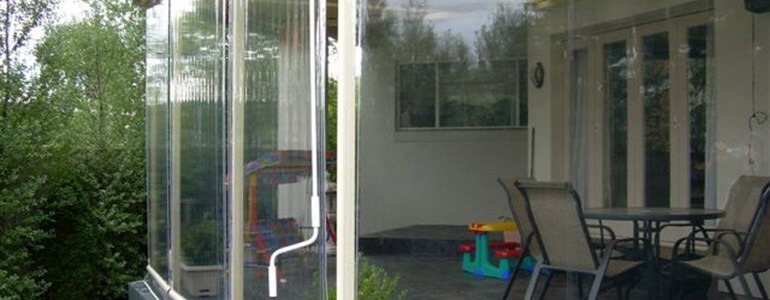
Clear PVC bistro blinds allow natural light while protecting diners from Melbourne’s weather — a popular choice across Brunswick, Richmond and Port Melbourne venues.
Melbourne’s alfresco dining culture has expanded dramatically over the past decade, particularly following changes to outdoor trading regulations across councils including the City of Melbourne, Port Phillip, Yarra, and Stonnington. Venues with well-protected outdoor areas consistently report meaningfully higher seat turnover, reduced cancellations on weather-sensitive days, and increased evening trading from shoulder seasons like April and October.
The challenge unique to Melbourne — compared to, say, Brisbane or Perth — is the sheer variability of conditions within a single day. A warm, still winter morning on Smith Street can give way to a 40 km/h southerly by midday. Fitzroy’s low-rise streetscape offers no natural windbreak. That’s why the combination of a quality canopy awning overhead with clear PVC bistro blinds on the sides has become the standard commercial configuration across Melbourne’s inner suburbs.
A door awning at your entrance also plays a dual role: it protects queuing customers and provides a clear branding touchpoint visible from the street. Canopy awnings with custom colour options are frequently used by venues across the CBD and South Yarra for exactly this purpose.
Commercial vs. Residential Awnings: Key Differences
This is probably the most underestimated distinction for café and restaurant owners who’ve previously installed awnings at home. Residential and commercial installations face fundamentally different compliance, structural, and operational demands.
| Factor | Residential | Commercial (Class 6 — Café/Restaurant) |
|---|---|---|
| Building Code | NCC Class 1a/1b | NCC/BCA Class 6 — stricter structural, fire & safety requirements |
| Wind Loading | Standard residential wind region | Must comply with AS/NZS 1170.2 — often requires engineering sign-off |
| Public Safety | Occupant-only risk | Liability extends to all members of the public — higher duty of care |
| Materials | Standard residential grade | Heavy-gauge aluminium frames, commercial-grade PVC (300–400µm), solution-dyed acrylics |
| Permit Requirement | Often exempt for small fixings | Usually requires a building permit and may require a planning permit depending on overlay |
| Fire Resistance | Standard | May require fire-retardant fabric depending on proximity to exits and building classification |
| Maintenance Cycle | Seasonal | Recommended 3–6 monthly inspections in commercial environments |
Compliance & Building Regulations for Café & Restaurant Awnings in Melbourne
Victoria’s regulatory framework for commercial awnings sits across three overlapping areas: the Building Act 1993 (Vic), the Building Regulations 2018 (Vic), the National Construction Code (NCC) 2022, and local council planning controls. Understanding where each applies saves you time and avoids costly non-compliant installations.
Building Permits
Under the Building Regulations 2018, an awning attached to a commercial building (Class 6 under the NCC) will typically require a building permit if it is structurally attached to the building fabric, exceeds certain size thresholds, or involves modification of an existing façade. A registered Building Surveyor must issue the permit. You can find registered surveyors through the Victorian Building Authority (VBA).
Planning Permits & Overlays
In addition to building permits, many Melbourne councils require a planning permit where a Heritage Overlay (HO), Design and Development Overlay (DDO), or Neighbourhood Character Overlay (NCO) applies. Fitzroy, Carlton, South Yarra, and St Kilda — all dense with hospitality venues — have significant heritage overlay coverage. The City of Melbourne and Yarra City Council have specific guidelines on signage and awning aesthetics in these zones.
Check your property’s planning overlays at VicPlan before proceeding with design. A heritage overlay doesn’t necessarily prevent awning installation, but it does shape what materials, colours, and mounting methods are permissible.
Food Act Considerations
Melbourne councils administering the Food Act 1984 (Vic) may assess your outdoor area as part of your food premises registration. An alfresco area enclosed with cafe blinds may be classified differently for licensing purposes than an open courtyard — this can affect your permitted operating hours, patron capacity, and the requirements around weatherproofing and drainage. Confirm this early with your council’s Environmental Health team.
Design & Branding Your Awning: Creating the Right First Impression
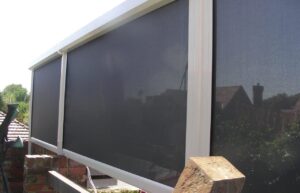
eZip blinds with branding panels create a cohesive frontage for Melbourne cafés — shown here in a clear PVC configuration maintaining sightlines to the street.
Your awning is the most visible element of your venue’s streetscape identity. In a competitive strip like Brunswick’s Sydney Road or Chapel Street in South Yarra, the difference between a well-designed awning and a generic one is measurable in foot traffic. Here’s what experienced Melbourne commercial venue designers consider:
Colour Selection
Solution-dyed acrylic fabrics from suppliers like Sunbrella or Dickson offer hundreds of colourways and retain colour under Melbourne’s UV exposure far better than standard coated fabrics. Choose colours that complement your interior, signage, and building facade. Councils with heritage overlays may prescribe a heritage palette — typically muted tones rather than high-contrast graphics.
Printed Canopies
Full-colour digital printing directly onto awning fabric is available for certain system types and allows you to incorporate your logo, brand colours, and messaging. The City of Port Phillip and Yarra City Council assess printed awnings as signage — confirm the planning permit requirements before ordering printed fabric.
System Aesthetics
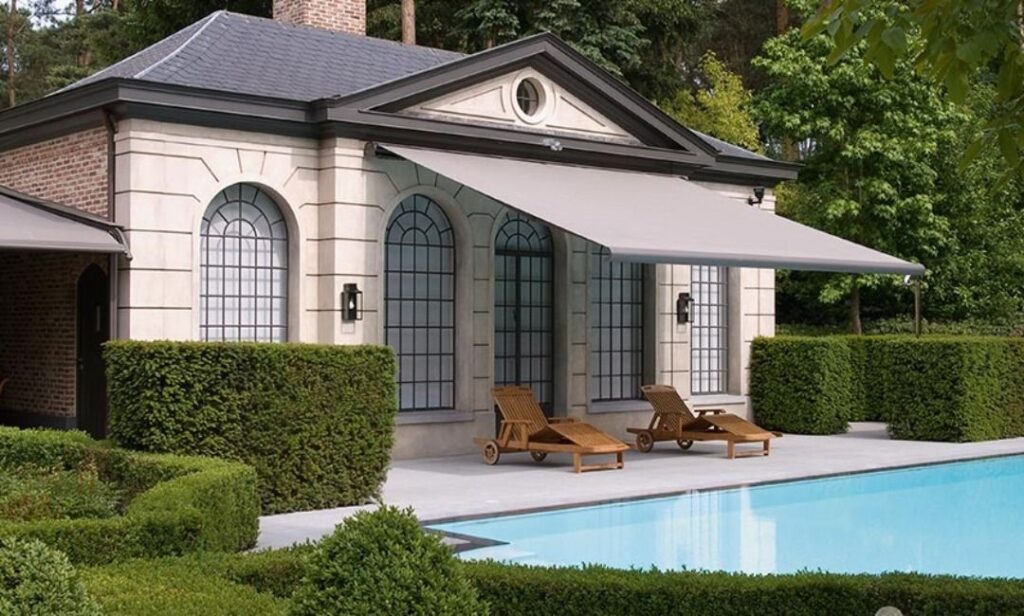
Folding arm awnings offer a clean, unobstructed view when extended and retract neatly into cassette housings. For venues prioritising a contemporary, minimalist look — common in Melbourne’s inner north café culture — a full cassette system like the Weinor Opal Design II provides a polished, low-profile aesthetic when retracted. Heritage venues in Carlton or Fitzroy often suit traditional canvas styles with scalloped valances.
Material & Structural Requirements for Commercial Installations
Melbourne’s specific weather profile — UV intensity from October to March, prevailing south-westerlies, coastal salt air in bayside suburbs, and periodic storm events — demands material choices that go well beyond what most residential product literature covers. Here’s how each material category performs in our climate:
Clear PVC — The Commercial Workhorse
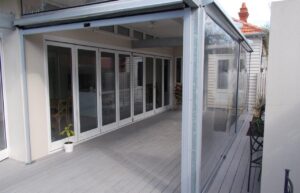
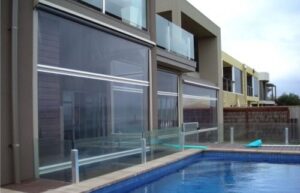
Marine-grade clear PVC at 300–400 microns is the dominant choice for café and restaurant side enclosures. It provides full wind and rain protection while maintaining sightlines and natural light — critical for venues where ambience depends on street visibility. UV-stabilised formulations resist yellowing; expect 8–12 years of commercial life with proper care. ZipTrak® and eZip systems use side-channel guides that eliminate fabric flapping under Melbourne’s gusty conditions — a key functional advantage over rope-and-pulley configurations in exposed locations.
Solution-Dyed Acrylic
For overhead shade structures, canopy awnings, and folding arm awnings, solution-dyed acrylic fabric (Sunbrella, Dickson, Sattler) is the commercial standard. The dye is integrated into the fibre rather than surface-coated, meaning colour retention and UV resistance are significantly superior. UPF 50+ ratings are standard across commercial-grade acrylics. These fabrics are also inherently water repellent and maintain their performance over high commercial use.
Sunscreen Mesh
Sunscreen mesh blinds offer UV and glare control with airflow — well-suited to venues in sheltered locations or internal courtyard configurations where ventilation matters more than wind exclusion. The openness factor (typically 3–10%) determines the balance between view preservation and solar rejection.
Structural Aluminium
Commercial awning frames must be powder-coated extruded aluminium conforming to Australian Standards for the relevant wind region. For Melbourne’s Wind Region A exposure (per AS/NZS 1170.2), commercial-grade systems from European manufacturers like Weinor and Gaviota are engineered and independently tested for wind load performance, providing the documentation required by building surveyors.
Find Your Ideal Cafe Blind or Awning Solution
Answer 6 quick questions — get a personalised recommendation for your Melbourne venue.
Durability, Maintenance & Care for High-Traffic Commercial Venues
A commercial cafe blind or awning operating 7 days per week across Melbourne’s seasonal extremes requires a maintenance programme, not just an installation. The leading cause of premature failure in commercial awnings isn’t UV or rain — it’s accumulated dirt and mould that isn’t addressed early enough.
Cleaning Schedule
For clear PVC blinds: rinse with fresh water monthly and apply a UV-stabilising protectant (such as 303 Aerospace Protectant) every 3–4 months. PVC blinds left unprotected will begin yellowing and crazing within 2–3 years under commercial use. For acrylic fabric awnings: brush off dry debris weekly, wash with diluted mild soap (never bleach) every 2–3 months, and re-treat with a fluorocarbon repellent annually.
Inspection Points
Every 3–6 months, inspect: mounting brackets and fixings for corrosion or loosening (particularly in bayside suburbs such as St Kilda, Brighton, and Williamstown where salt exposure is elevated); guide channels for debris and wear; fabric seams and welds for delamination; and motorised systems for motor, receiver, and remote function. Engage a professional for any structural fixings — do not attempt DIY remediation of building-mounted brackets on a commercial installation.
Wind Events
Following any severe weather event, retract motorised systems before winds exceed the system’s rated threshold (typically 40–60 km/h depending on specification). Manual systems should be retracted whenever the venue is closed or unattended. A Somfy or Becker wind sensor integrated with your motorised system can automate this — strongly recommended for bayside and exposed inner-city locations.
Motorised vs. Manual: Operation & Control Options
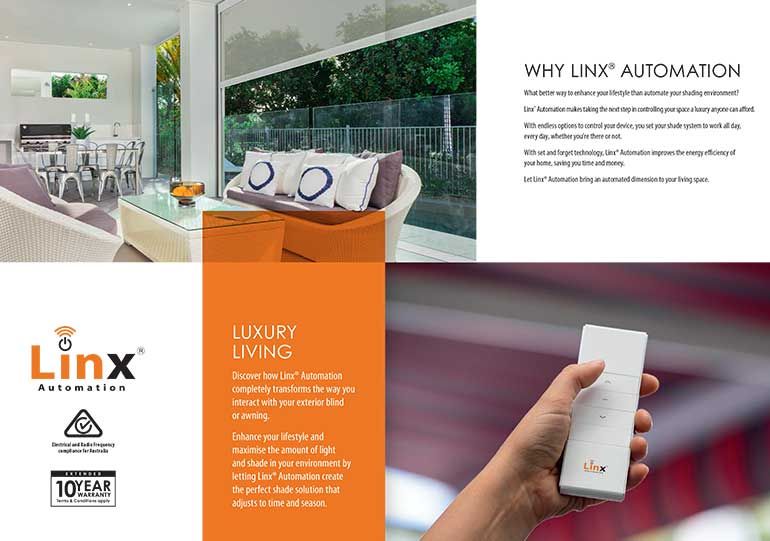
AAG LINX Automation enables smartphone control and wind/sun sensor integration for motorised cafe blind and awning systems — popular in Melbourne commercial venues.
For commercial venues, the operational question of motorised versus manual is less about preference and more about staff efficiency and risk management. Here’s the honest comparison:
Motorised Systems — Best For:
- Venues with large or multiple awning spans (hand-cranking a 6m+ folding arm awning multiple times per day is demanding)
- Locations exposed to Melbourne’s variable weather where rapid deployment matters
- Integration with automation systems (wind sensors, sun tracking, remote control via app)
- Reducing staff fatigue and manual handling injury risk
Manual Systems — Best For:
- Smaller spans (up to approx. 4m) where the mechanism is proportionate
- Venues with limited electrical access to the awning zone
- Rope-and-pulley or geared roller configurations suited to heritage aesthetics
- Budget-sensitive projects where the operational load is manageable
Melbourne Shade Systems installs Somfy and Becker motorisation systems — two of the most reliable commercial motor brands available in Victoria. Both offer wind and sun sensor integration, remote control, and smartphone connectivity. The AAG LINX Automation system provides a particularly clean integration for venues running multiple awning zones.
Safety & Liability Considerations for Customer and Staff Protection
This section is frequently absent from competitor resources and is one of the most important for commercial venue operators. Under Victoria’s Occupational Health and Safety Act 2004 and Wrongs Act 1958, venue operators owe a duty of care to both employees and members of the public using their premises. An awning or cafe blind that fails structurally — whether through inadequate installation, deferred maintenance, or improper wind loading specification — can expose the operator to significant liability.
Key Safety Requirements
- Minimum 2,400mm clear height for awnings over pedestrian pathways (Building Regulations 2018, Part 6 — check with your building surveyor for site-specific requirements)
- No protrusion onto the public footpath without council consent — the City of Melbourne’s Local Law No. 1 governs footpath trading structures in the CBD and inner suburbs
- Structural engineering signoff required for awnings attached to structural elements or spanning beyond standard residential dimensions in a commercial context
- Emergency egress clearance — awnings must never obstruct required exit paths under the NCC/BCA
- Annual professional inspection of all structural fixings — document and retain records as part of your due diligence defence
Budget, ROI & Long-Term Value for Commercial Awnings
Commercial awning investment should be evaluated as a revenue-generating asset, not a fit-out cost. The frame for thinking about ROI for Melbourne venue operators:
Revenue Uplift
Melbourne café and restaurant operators consistently report meaningfully higher cover counts on rainy or gusty days once quality cafe blinds are installed. In practical terms, an alfresco area that was previously unusable 30–40% of operating days becomes usable year-round. For a venue with 20 outdoor covers at average Melbourne spend per cover, the annual revenue gain is tangible and rapid relative to installation cost.
Energy Cost Reduction
External shading is the most effective form of passive cooling available to a commercial building. A folding arm awning or sunblind over north or west-facing windows can reduce internal cooling loads substantially — a benefit recognised in NABERS commercial energy assessments.
Life Expectancy
Quality commercial-grade systems from European manufacturers, properly maintained, have working lives of 12–20 years. Factor replacement cycles into your depreciation planning, particularly for fabric components (typically 8–12 years) versus structural aluminium elements (15–20+ years).
Strata & Shared Space Considerations for Multi-Tenant Venues
A significant proportion of Melbourne’s inner-city hospitality venues occupy strata-titled commercial buildings — particularly in the CBD, Southbank, and mixed-use precincts in South Melbourne and Collingwood. If your tenancy is within a strata scheme, the Owners Corporations Act 2006 (Vic) governs your ability to install awnings on common property (which typically includes the exterior facade).
Before any awning installation in a strata building: obtain written consent from the Owners Corporation; confirm the proposed works comply with the OC’s rules and any building management statement; and engage a licensed contractor familiar with strata modification protocols. Some OC rules require the installation to be reversible — important for product and system selection.
Your property manager or the Consumer Affairs Victoria — Owners Corporations resource can provide guidance on the consent process.
Council Approval Timeline & Compliance Pathway
Here’s a realistic, step-by-step compliance pathway for a Melbourne café or restaurant awning installation as of May 2026:
-
Check VicPlan for Overlays Visit mapshare.vic.gov.au/vicplan to identify Heritage, Design and Development, or other relevant overlays on your property. This determines whether a planning permit is needed in addition to a building permit.
-
Pre-Application Meeting with Council Contact your local council’s planning department for a pre-application meeting. Bring concept drawings, proposed materials, and the system specification sheet. Councils such as City of Yarra, Stonnington, and City of Melbourne have planning help desks. Timeline: 1–2 weeks to arrange.
-
Engage a Registered Building Surveyor Your chosen surveyor will advise on whether a building permit is required, issue the permit, and inspect the installation. Find a registered surveyor via the VBA’s register. Timeline: 1–3 weeks for appointment and initial assessment.
-
Submit Planning Permit Application (if required) For properties with applicable overlays, submit a planning permit application to your council including drawings, material schedule, and heritage impact assessment if required. Timeline: 4–12 weeks standard; heritage overlays may extend to 6 months.
-
Building Permit Issued & Installation Proceeds Once planning (if needed) and building permits are issued, installation can proceed. A compliant commercial installation typically takes 1–3 days on-site. Permit documentation must be retained.
-
Mandatory Inspection & Certificate of Final Inspection Your building surveyor will conduct the mandatory inspection upon completion. Retain the Certificate of Final Inspection — it confirms compliance and supports your insurance position.
Installation Process & Timeline Expectations
A commercial cafe blind or awning installation by Melbourne Shade Systems follows a structured process from first consultation through to handover:
- Initial Consultation & Site Measure: An experienced consultant visits your venue to assess the space, discuss objectives, and take precise measurements. Structural mounting points are assessed.
- Design & Specification: Custom design drawings are produced, fabric and system selections are confirmed, and the specification package is prepared (used for permit applications if required).
- Manufacturing Lead Time: Custom commercial systems are typically manufactured to order. European systems from Weinor, Gaviota, and others have current lead times of 4–8 weeks from order confirmation.
- Installation Day(s): Commercial installations are typically 1–3 days depending on system complexity and number of spans. Melbourne Shade Systems coordinates installation around venue trading hours where possible.
- Handover & Training: Full operational demonstration and care instructions are provided to venue staff. Motor programming, sensor calibration, and remote pairing are completed.
Customisation & Branding Options for Commercial Awnings
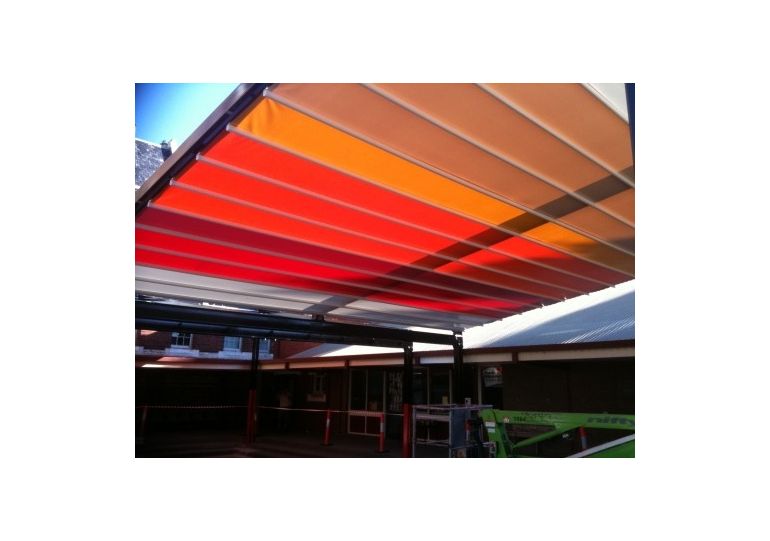
Melbourne Shade Systems’ extensive awning fabric range allows venue owners to match brand colours precisely — available across canvas, acrylic, mesh and PVC options.
Melbourne’s hospitality market is highly design-conscious, and your awning is an extension of your brand. Customisation available through Melbourne Shade Systems includes:
- Custom colour matching across hundreds of solution-dyed acrylic and canvas colourways — including RAL and Pantone matching where available
- Powder-coat frame colours matched to your building’s metalwork, signage, or interior palette
- Valance profiles — straight, scalloped, or contemporary cut — to suit your venue’s design character
- Illuminated valances for evening trading — integrated LED lighting strips within the awning valance increase visibility and atmosphere after dark
- Printed fabric for selected system types — logo, tagline, or graphic elements printed directly onto the awning fabric (confirm planning permit requirements for signage)
Explore the full awning fabrics range and view the product brochures to compare options before your consultation.