

What They Are, Every Type Explained, Benefits, Materials, Cost, and How to Choose the Right One
Melbourne’s Summer Heat Is Coming Through Your Windows. There Is a Better Answer
Is it your west-facing room unusable from 2 pm to 7 pm every summer? Has your air con running since 9 am? If yes, then you are at the right spot to remove such issues.
Most homeowners in Melbourne don’t know that internal blinds and curtains are the wrong solution to a solar heat problem. They engage after the heat has already entered through the glass of your window.
The solution that building architects, energy consultants, and outdoor shade specialists have recommended for decades is external solar control — blocking the heat before it enters the glass. We at Shade Systems have brought you the most accessible, cost-effective and visually appealing form of external solar control for Melbourne homes that is Window Awnings.
A window awning is fitted above the window on the outside of the building, and they intercept the sun before it reaches the window. Isn’t it something you have been thinking of having? Sure, you do!
In this guide, we will explain:
- Every type of window awning available
- Which style suits your window orientation
- Fabric and material options
- Motorisation choices
- Realistic Melbourne pricing
- How to choose the right system for your home
But before the how-to, let’s define exactly what a window awning is, because this product category is broader than most people realise.
Without any delay, let’s get into reading-
What Are Window Awnings?
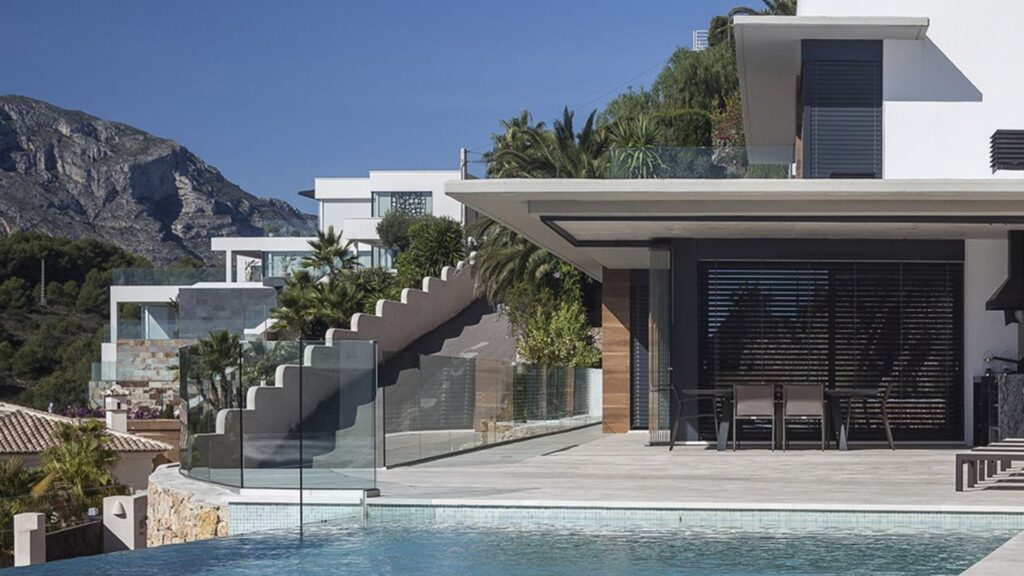
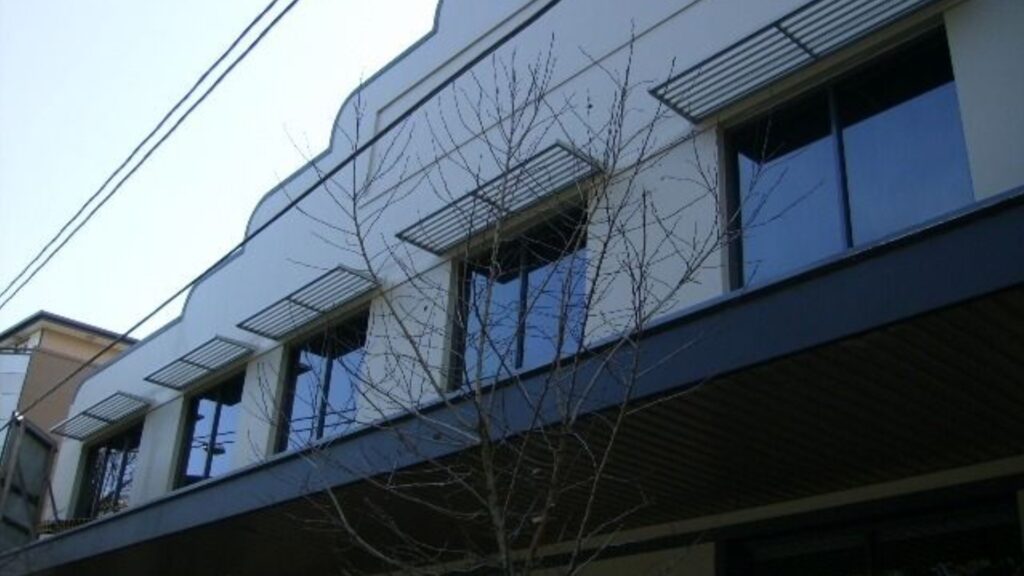
A window awning — also known as a window shade or window canopy — is an overhanging secondary cover attached to the exterior wall of a building, directly above a window. It projects outward from the wall to intercept sunlight before it strikes the glass, blocking solar heat from entering the room.
At Shade Systems, window awnings are constructed with extruded aluminium frames and are available in a wide range of fabrics — including acrylic canvas, cotton and polyester blends, shaded mesh, and PVC-coated textiles for rain protection. Metal louvre systems are also part of the window awning category.
The key distinction that separates window awnings from other outdoor shade products: they are fixed to the wall above a window, and their purpose is to reduce solar heat entering through that specific window. They are not patio covers, not alfresco enclosures, and not overhead shade sails — they protect the building’s glass from direct sun.
Window Awnings vs Other Outdoor Shade Products
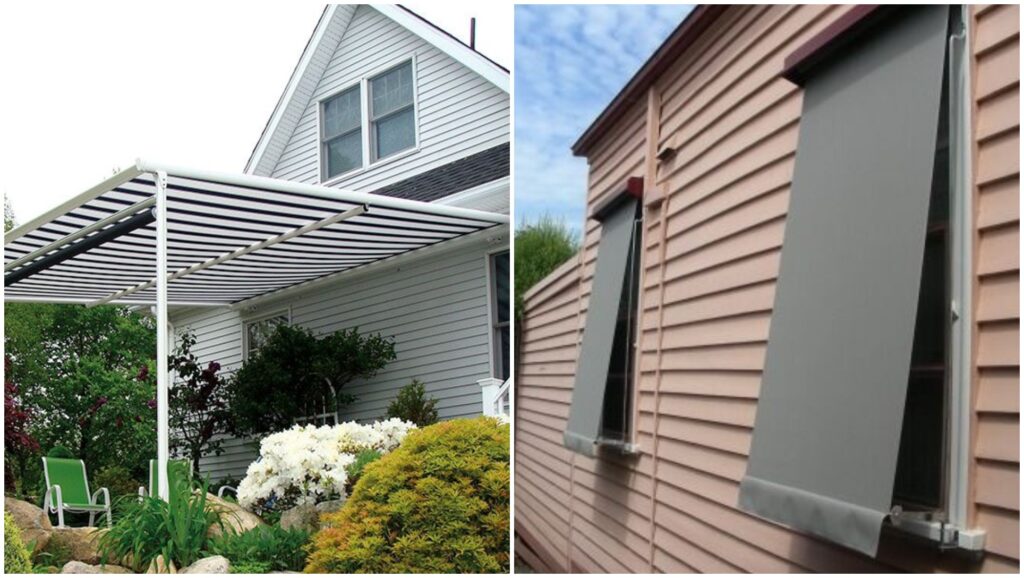
In this section, you will learn more about the outdoor shade category as it uses some overlapping terminology that includesawnings, shades and window, windows with awnings, and window awning blinds — it helps to see how window awnings compare to the broader product family:
| Product | Position | Primary Purpose | Does NOT Do |
| Window Awnings / Window Shades | Above a window — wall-mounted | Block solar heat through window glass | Protect outdoor areas or alfresco sides |
| Drop Arm Awnings | Above window / glass wall — wall-mounted | Flexible angle shading — adjustable projection | Fully seal a space; limited rain protection |
| Folding Arm Awnings | Overhead — projects from wall or beam | Shade a patio or deck from above | Protect window glass specifically |
| Retractable Patio Roof | Overhead — full patio coverage | Complete overhead rain and sun cover | Address window-level heat gain |
| Shade Sail / Shade Structure | Overhead — stretched between anchors | Block overhead sun — shade sail shade | Protect windows or enclose sides |
| Cafe Blinds / PVC Bistro Blinds | Vertical — patio sides | Enclose alfresco from wind and rain | Block heat through interior windows |
| Canopy Awnings | Above door or window — wall-mounted | Architectural weather cover — rain and character | Adjustable solar control |
Window awnings and drop arm awnings are both wall-mounted above windows — but they work differently.
| Why ‘External Solar Control’ Matters for Melbourne Melbourne’s UV index reaches ‘Extreme’ ratings regularly in summer — even on partly cloudy days. External window shading blocks solar radiation before it passes through the glass. Internal curtains and blinds allow solar heat to enter the room first, then try to manage it. The difference in interior temperature between a room with external window awnings and one relying only on internal blinds can be 4°C to 8°C on a peak Melbourne summer day — directly reducing air conditioning load and energy costs. |
Now the types — because ‘window awning’ covers significantly more product variety than most people expect. Each type suits a different window orientation, home style, and level of adjustability.
Types of Window Awnings — Every Style Shade Systems Supplies
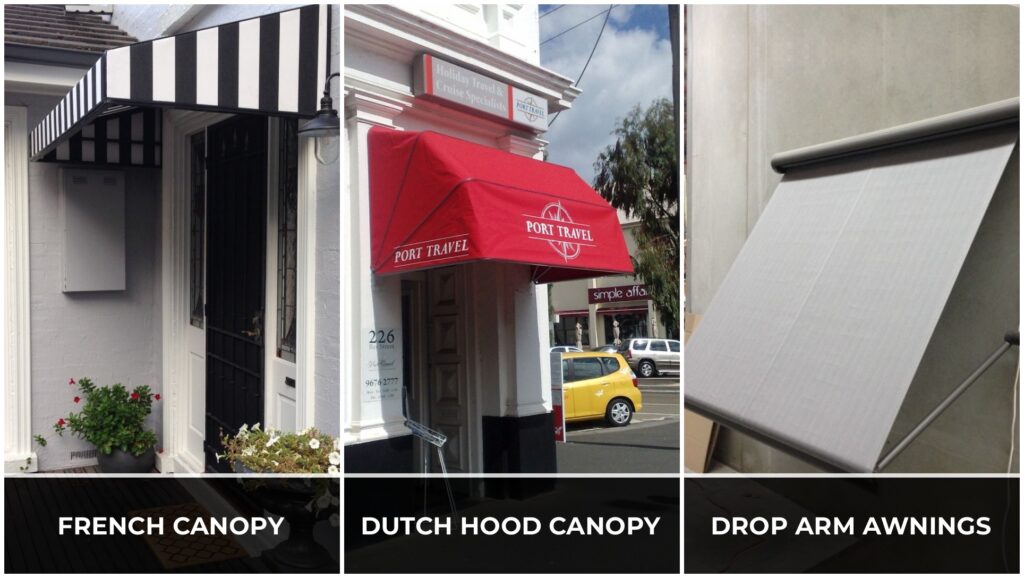
We have a huge range of window awnings. Here is every type, explained clearly:
1. Drop Arm Awnings
Drop arm awnings are wall-mounted above a window or glass wall, using two folding arms to project the awning fabric outward and downward at an adjustable angle. As we describe them: they are highly versatile and suitable for windows that face in any direction, and provide protection from the sun at all levels.
The adjustable arm angle allows you to control exactly how much of the window is shaded at different times of day — you can lower the arms to create more shade when the sun is lower in winter, or raise them for a more horizontal projection in summer. This adjustability makes drop arm awnings one of the most popular exterior window awnings for Melbourne homes.
- Twin-drop arm awnings — two separate arms per window, allowing independent height control on each side
- Available in all Shade Systems fabric types: acrylic canvas, shaded mesh, opaque and sheer options
- Manual or motorised operation
2. French Canopy
A French canopy is a fixed or semi-fixed window cover with a curved or sloped profile that projects from the wall above the window. It takes its name from traditional European architectural style — and is sometimes called a bow canopy.
French canopies provide a permanent architectural feature above the window, offering weather protection (rain and sun) while adding strong visual character to the home’s exterior. They are particularly popular on heritage-style and period Melbourne homes where the decorative quality matches the home’s architecture.
- Fixed projection — not retractable
- Strong rain protection as well as sun shading
- Distinctive European character — suits heritage, Victorian, and period-style Melbourne homes
- Fabric or metal construction depending on design
3. Dutch Hood Canopy
A Dutch hood canopy is similar to a French canopy in that it provides a fixed architectural cover above a window, but with a distinctive angular or hipped profile rather than a curved one. It provides solid overhead protection from rain and sun, and adds a traditional, structured character to the home’s facade.
- Angular, structured profile — different aesthetic to the curved French canopy
- Fixed installation — permanent weather cover
- Popular for traditional and contemporary homes seeking a structured canopy look
- Extruded aluminium frame construction
4. Retractable Window Shade / Motorised Window Awning
Retractable window shades are window awnings that can be extended or retracted as needed. At Shade Systems, motorised window awnings are available — operated by wall switch, remote control, or weather sensor integration through Somfy or Becker motor systems.
A motorised window awning is the premium option for windows used daily — particularly west-facing windows that need the awning deployed most weekday afternoons and retracted in the evenings. Automation removes the need to remember to adjust the awning manually and prevents leaving fabric extended in high-wind conditions.
- Manual retractable — crank or strap operation, cost-effective, suitable for occasional use
- Motorised retractable — Somfy or Becker motor, wall switch or remote control
- Sensor-linked — wind and sun sensors can automatically retract the awning when wind exceeds safe limits
5. External Venetian Blinds — Griesser Range
Shade Systems supplies the Griesser range of external venetian blinds — a premium window shade solution that provides precise, adjustable light control while maintaining visibility and ventilation.
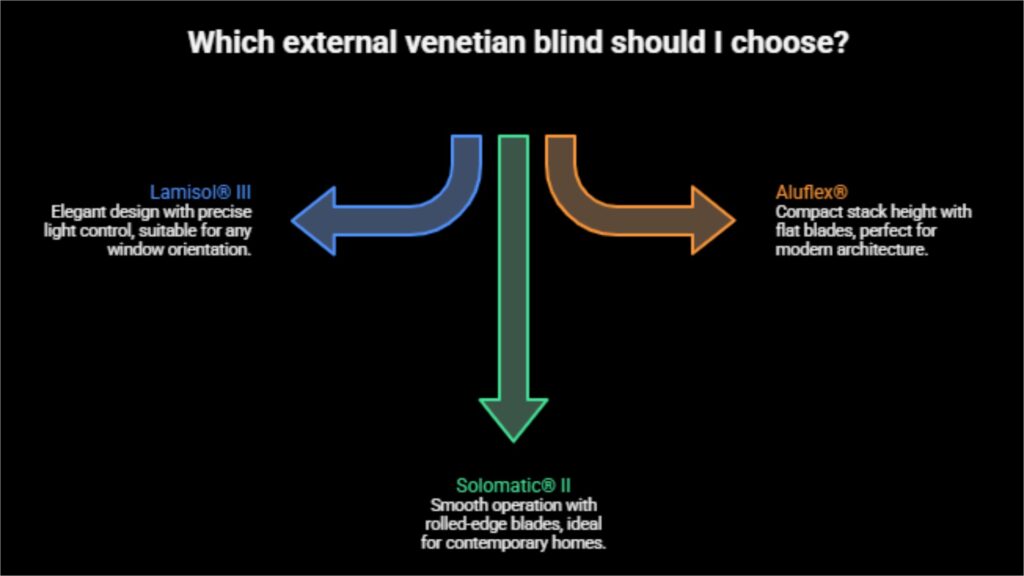
| Product | Type | Key Feature | Best For |
| Lamisol® III (Griesser) | External venetian blind — best-selling | Elegant design with precise light control per blade | Any window orientation — maximum adjustability |
| Solomatic® II (Griesser) | External venetian blind | Rolled-edge blade design, smooth reliable operation | Contemporary homes — clean aesthetic |
| Aluflex® (Griesser) | External metal venetian blind | Flat blade profile, compact stack height | Modern architecture — sleek, minimal look |
External venetian blinds are different to standard awnings — the individual adjustable blades allow precise control over light, heat, and privacy at every angle. They are a form of external window awning blinds that combines solar control with the visual flexibility of louvre-style light management.
6. Sun Louvres / Cantilevered Awnings
Sun Louvres are cantilevered awnings — the modern, sleek design of today’s passive louvre systems. The cantilever relies on a specially designed welded bracket, creating a horizontal fixed louvre that intercepts sun at high angles (summer) while allowing low-angle winter sun to pass underneath. This is the most architecturally integrated window shade solution in the range — often specified for new construction or major renovations.
- Fixed installation — permanent passive shade
- Intercepts high summer sun, allows low winter sun — passive solar design principle
- Contemporary architectural aesthetic
- Suitable for large window expanses and commercial facades
Opaque vs Sheer Fabric Options
Across all fabric-based window awning types, we offer two levels of fabric density:
| Fabric Type | What It Does — and When to Choose It |
| Opaque fabrics (canvas, heavy acrylic) | Complete sun block-out. Maximum heat reduction. Maximum privacy from street level. Best for west-facing windows with intense afternoon sun exposure. |
| Sheer / shade mesh fabrics | Sun and heat protection while preserving some view and natural light. Better for north-facing windows where some light is desirable but glare needs reduction. |
| PVC-coated textiles | Rain protection as well as sun shading. Best for windows exposed to driven rain or for locations where weather-sealing is needed, not just sun control. |
You know what every type is. Now the question that matters for your Melbourne home specifically — what does installing window awnings actually change about your daily life and your bills?
Benefits of Window Awnings for Melbourne Homes
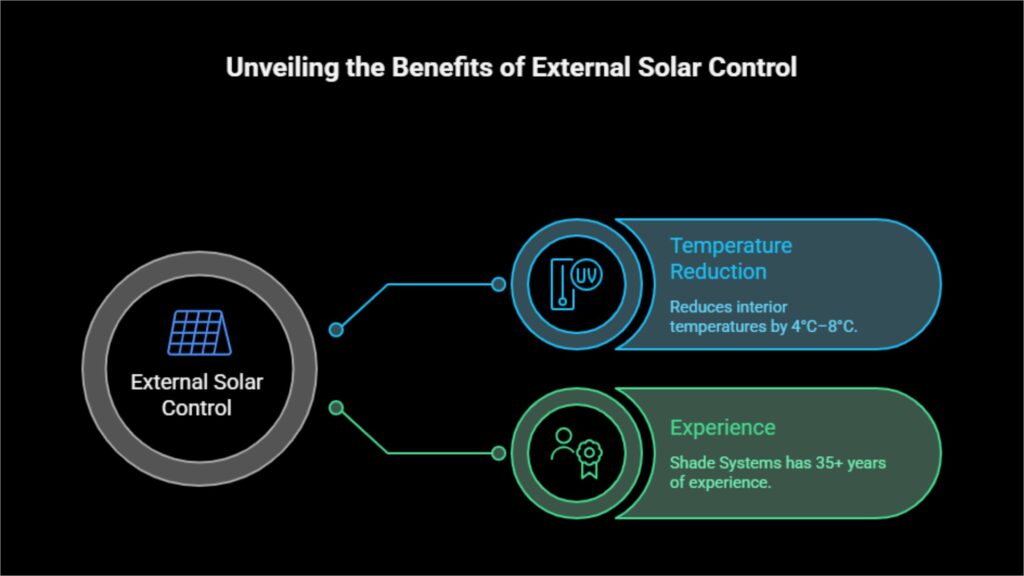
| External Solar control stops heat before it enters — more effective than any internal blind | 4°C–8°C Potential interior temperature reduction in rooms with west-facing windows in summer | 35+ yrs Shade Systems’ experience installing across Melbourne |
Benefit 1: Reduce Heat Inside Your Home — At the Source
The most significant practical benefit of exterior window awnings is stopping solar heat before it passes through the glass. Internal blinds manage heat after it enters — external window awnings prevent it from entering in the first place. This is why building energy rating assessors include external shading in their calculations and why architects specify window awnings in energy-efficient home designs.
In Melbourne, west-facing windows are the most critical application — afternoon sun from the west in summer is the primary source of late-afternoon overheating in Melbourne homes. A correctly installed drop arm awning or fixed canopy on a west-facing window significantly reduces the heat load on that room and on the entire home’s cooling system.
Benefit 2: Lower Air Conditioning and Energy Costs
When your air conditioner runs less — because less heat is entering your home through the glass — your energy bills reduce. External window shade solutions like awnings and external venetian blinds reduce the cooling load on your air conditioning system. This benefit is most pronounced on west-facing windows in Melbourne’s summer afternoon heat, and on north-facing windows where winter sun can also create heat gain on warmer winter days.
Benefit 3: Protect Furniture and Flooring from UV Fade
Melbourne’s UV levels regularly reach ‘Extreme’ ratings in summer — damaging enough to fade fabric, timber flooring, carpet, and artwork near windows over time. External window awnings reduce the intensity of UV reaching the interior — protecting your furnishings without blocking all the natural light.
Benefit 4: Weather Protection for Windows and Walls
Fixed window canopies — French canopies, Dutch hood canopies, and bow canopies — provide permanent weather cover above windows. This protects window frames and sills from rain damage, extends the life of paint and sealant around window frames, and reduces the frequency of moisture entering around window seals. In Melbourne’s unpredictable rain pattern, this protection is practical as well as aesthetic.
Benefit 5: Kerb Appeal and Property Value
A well-chosen set of window awnings significantly changes the exterior appearance of a Melbourne home. When colour-matched to the home’s palette and consistent across all windows, they create a cohesive, finished exterior aesthetic that distinguishes the property on the street. A coordinated shades and window system — where window awnings match drop arm awnings, cafe bistro blinds, and folding arm awnings across the property — is one of the most cost-effective exterior upgrades available to Melbourne homeowners.
Benefit 6: Wind and Rain Protection (Selected Types)
Drop arm awnings, French canopies, and Dutch hood canopies provide limited protection from wind and rain for the window area beneath them. While they are not full weather enclosures (that role belongs to retractable patio roof systems and PVC cafe blinds), they do reduce the exposure of the window frame to driven rain — a practical maintenance benefit for Melbourne’s year-round weather variability.
Benefits are clear. Now let’s see what architects say about them.
Why Architects Specify External Window Awnings in Energy-Efficient Homes
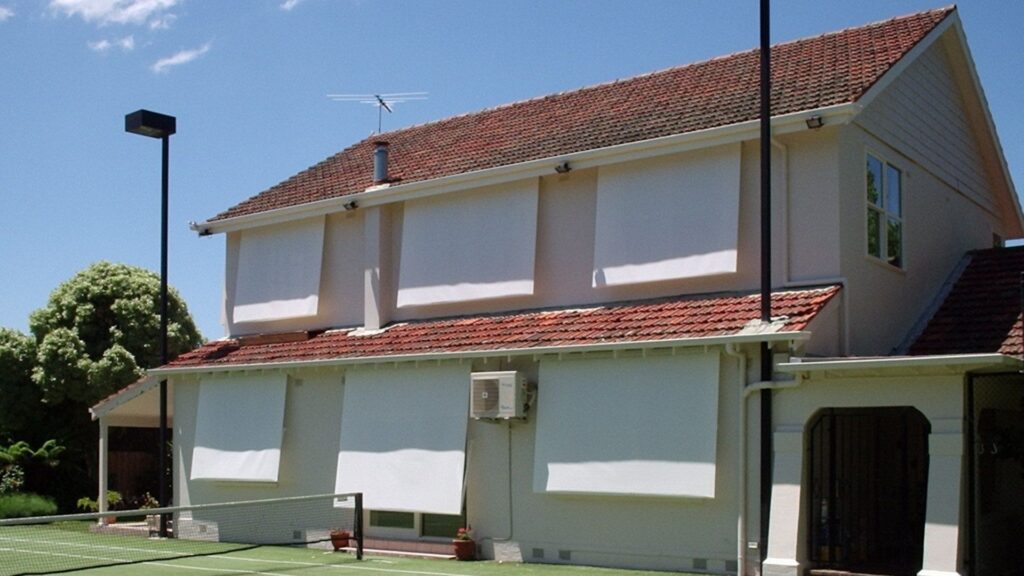
In Melbourne’s climate, glazing is the weakest thermal point of most homes. Even double glazing allows significant solar gain when exposed to west or north-facing sun.
That’s why passive solar design principles — used in NatHERS-rated homes — prioritise external shading over internal blinds.
External window awnings:
- Intercept solar radiation before it passes through glass
- Reduce cooling load on air conditioning systems
- Improve overall energy efficiency ratings
- Support passive summer shading while allowing winter sun (when correctly designed)
This isn’t just a comfort upgrade — it’s building-science backed performance.
But which material delivers those benefits most effectively in Melbourne’s specific conditions? The material decision determines both performance and longevity. Let’s see that in the next section.
Window Awning Materials — What Shade Systems Use
Every window awning from Shade Systems is built on an extruded aluminium frame — the industry-standard structural material for external awnings in Melbourne’s UV and weather environment. Aluminium is corrosion-resistant, lightweight, and maintains its shape under UV exposure. The frame is powder-coated in Colorbond colours to match your home’s exterior.
The fabric or surface material mounted on that frame is the second major choice:
| Material | UV Resistance | Rain Resistance | View Preserved? | Best Application |
| Acrylic canvas (standard) | High — colour-stable, UV-resistant | Moderate — sheds water, not waterproof | No — opaque | All-direction windows — full sun block-out desired |
| Heavy canvas (cotton/polyester blend) | Good | Moderate | No — opaque | Traditional aesthetic — period and heritage homes |
| Shaded mesh (shade cloth) | High | Low — mesh lets water through | Partial — some view and light transmission | North-facing windows where some light is desired with heat reduction |
| PVC-coated textile | High | High — waterproof | No — opaque | Windows exposed to driven rain — weather sealing needed |
| Metal / aluminium louvre (Griesser, Sun Louvres) | Very high — no fabric to degrade | High — louvre deflects rain | Partial — adjustable louvre angle controls light | Modern architecture — permanent passive solar design |
| External venetian slats (Griesser: Lamisol®, Solomatic®, Aluflex®) | Very high — aluminium blades | High — water runs off blades | Adjustable — tilt blades for full privacy or full view | Any window — maximum light control flexibility |
Colour and Customisation
We offer window awning fabrics in a range of colours and patterns to match any home exterior. Opaque fabric options provide complete sun block-out in whatever colour suits the home. Sheer fabric options deliver sun and heat protection without compromising the view from inside — ideal for rooms where natural light and outlook are priorities.
Frame colours are available in the Colorbond range — including Monument, Surfmist, Paperbark, Ironstone, and others — so the awning frame coordinates with guttering, window frames, and any other existing awnings installed on the property.
Materials understood. Now the question that determines whether this project fits your budget — and why the price range is much wider than most people expect before they start researching.
Window Awnings Prices — What to Expect in Melbourne
Window awnings are custom-manufactured to the width and projection of each specific window, so window awnings prices are always quoted per installation. The price depends on the type of awning, the width and projection size, the fabric choice, whether motorisation is included, and site-specific installation conditions.
The following are indicative price ranges for professionally supplied and installed window awnings in Melbourne. These are estimates only — always request a written, itemised quote from any supplier. We provide free consultations and written quotes with no obligation.
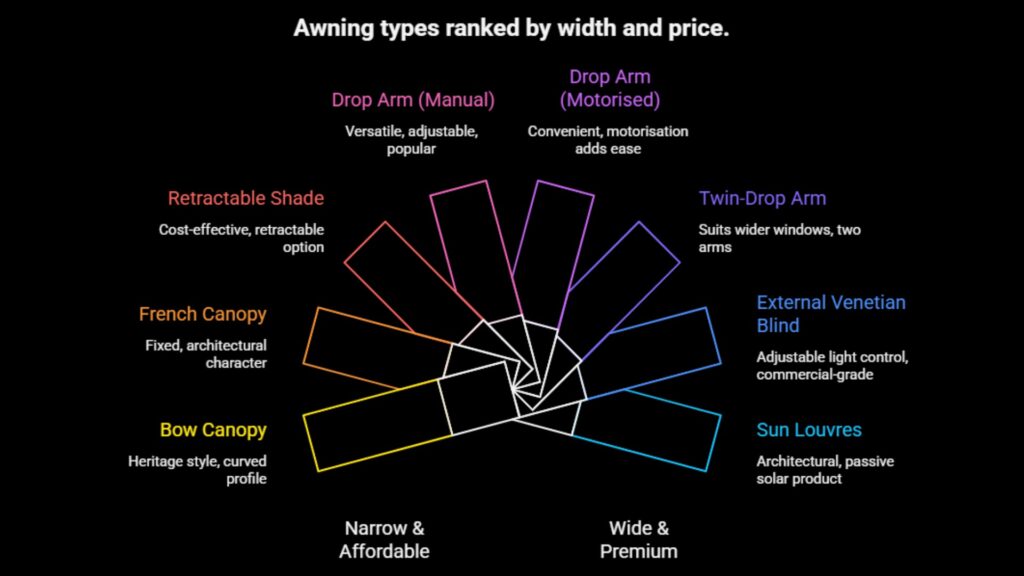
| Awning Type | Width Range | Approx Price Range (Installed) | Notes |
| Drop Arm Awning (manual) | Up to 3m wide | $800 – $1,800 per window | Most popular choice — versatile and adjustable |
| Drop Arm Awning (motorised — Somfy/Becker) | Up to 3m wide | $1,400 – $2,800 per window | Motorisation adds convenience for daily use |
| Twin-Drop Arm Awning | Up to 4m wide | $1,200 – $2,600 per window | Two independent arms — suits wider windows |
| French Canopy / Dutch Hood Canopy | Up to 2m wide | $900 – $2,200 per window | Fixed — architectural character, rain + sun cover |
| Bow Canopy | Up to 1.8m wide | $800 – $1,800 per window | Curved profile — heritage and period style |
| Retractable Window Shade (manual) | Up to 2.5m wide | $700 – $1,600 per window | Cost-effective retractable option |
| External Venetian Blind (Griesser Lamisol® / Solomatic® / Aluflex®) | Custom to window | $1,500 – $3,500+ per window | Premium adjustable light control — commercial-grade |
| Sun Louvres / Cantilevered Awning | Custom to window span | $1,800 – $4,500+ per window | Architectural passive solar product — new build spec |
What Affects the Price
- Width and projection — wider and deeper projections use more material and stronger frame hardware
- Fabric choice — acrylic canvas is standard; Griesser external venetian systems are premium
- Manual vs motorised — Somfy or Becker motor adds $400 to $800 per window depending on motor grade
- Number of windows — multi-window installations on a single property often achieve better rates than single-window quotes
- Site access — upper-floor windows may require scaffold ($300 to $600 additional)
- Masonry vs timber fixing — drilling into brick or concrete adds cost and requires specific fixings
| Value Comparison: Window Awnings vs Internal Blinds A premium internal blind on a west-facing window costs $300 to $800 and reduces heat that has already entered the room. A drop arm window awning on the same window costs $800 to $1,800 and stops the heat before it enters the glass, making the room 4°C to 8°C cooler on peak summer days, directly reducing air conditioning runtime and energy costs. Over a Melbourne summer, the energy saving partially offsets the cost difference. |
Get an Exact Quote for Your Windows
Every window is different — orientation, width, exposure, and access all affect the solution.
Shade Systems provides:
- Free on-site measurement
- Written, itemised quotes
- Fabric and frame colour consultation
- Motorisation recommendations if suitable
Call (03) 9595 9000
or request a free consultation online today.
Stop guessing. Get the right solution designed properly.
Quick Decision Guide: Which Window Awning Is Right for You?
West-facing window?
→ Drop Arm Awning (motorised recommended)
North-facing window?
→ Sheer fabric drop arm or external venetian for adjustable light control
Heritage or period home?
→ French canopy or Dutch hood canopy
Building new or renovating?
→ Sun Louvres / Cantilevered fixed system
Want precise light and privacy control?
→ External Venetian Blinds (Griesser range)
If you’re unsure, Shade Systems provides free on-site assessments across Melbourne.
Budget framed. Now the decision process — how do you match the right type, material, and operation system to your specific windows, your home’s style, and Melbourne’s conditions?
How to Choose the Right Window Awning for Your Melbourne Home
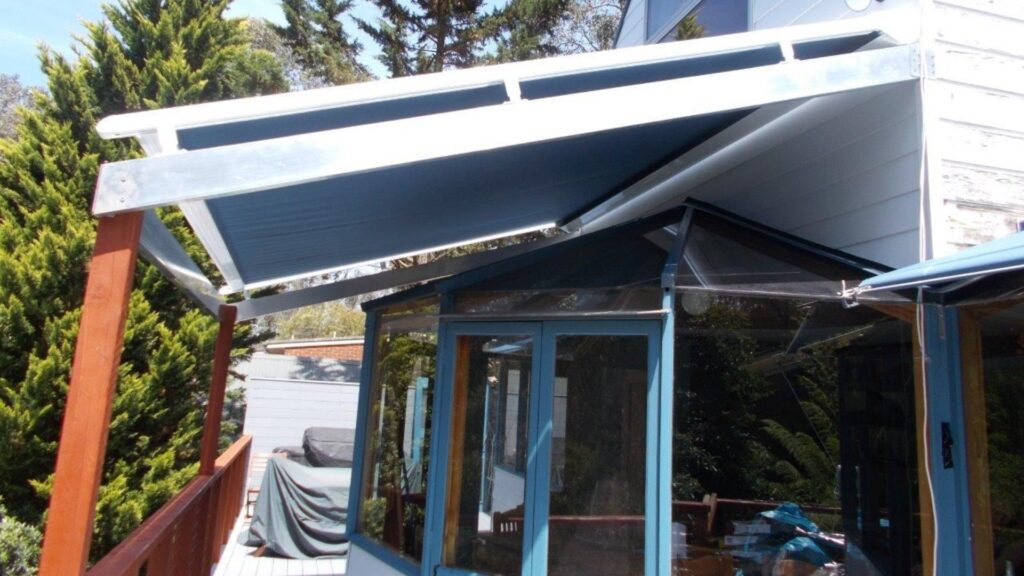
The right window awning depends on four things: which direction the window faces, what the window looks at (view or wall?), what the home’s architectural style is, and how often you want to adjust the awning. Work through these four questions in order.
Step 1: Window Orientation — The Most Important Factor
In Melbourne, the direction a window faces determines which threat matters most:
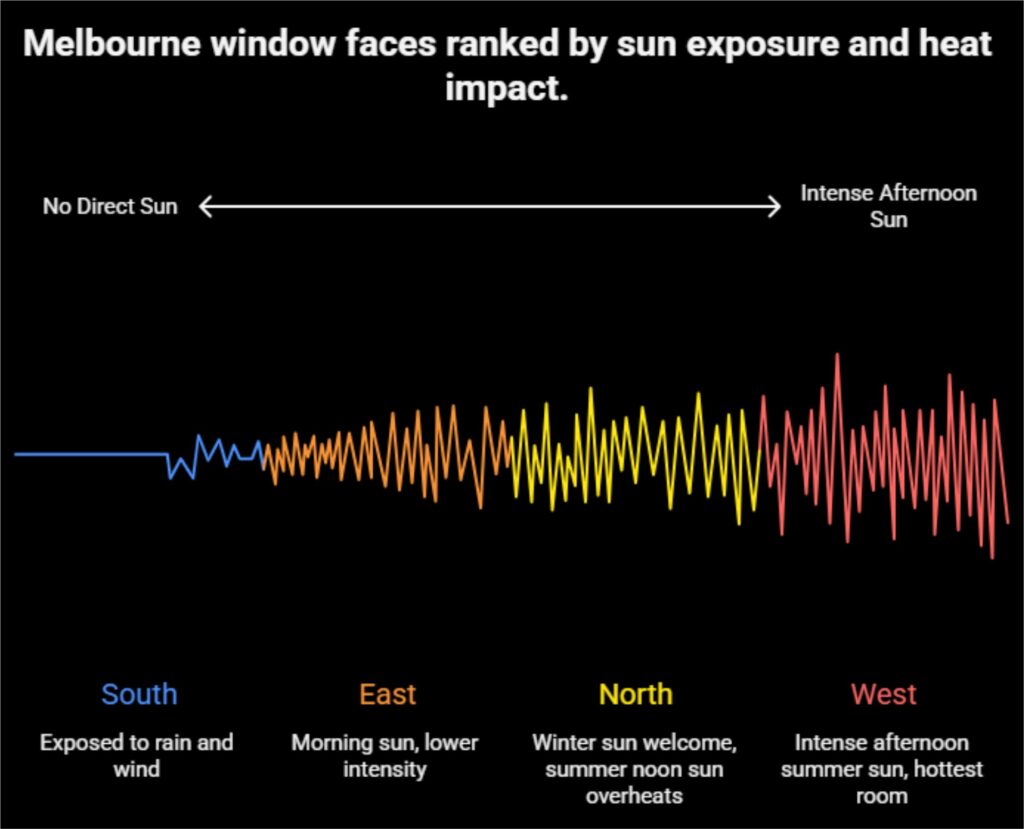
| Window Faces | Primary Challenge in Melbourne |
| North | Winter sun welcome but summer noon sun can overheat — lower sun angle |
| West | Intense afternoon summer sun — the hottest room in most Melbourne homes |
| East | Morning sun only — lower intensity, less critical |
| South | No direct sun — rain and wind exposure instead |
Step 2: Do You Want Adjustability or a Permanent Fixed Solution?
This determines whether you need a retractable product or a fixed canopy:
- Fixed canopy (French, Dutch hood, bow) — permanent, low maintenance, architectural character. Choose if you want a set-and-forget solution that looks built-in.
- Manual retractable (drop arm, crank) — flexible, cost-effective. Best if you want to adjust daily but don’t need automation.
- Motorised window awning — maximum convenience. Best for frequently used windows, for occupants who prefer automation, or for properties with many windows to control simultaneously.
- External venetian or louvre — maximum control over light and privacy. Best for rooms where precise light management matters — home offices, bedrooms, living rooms with TV glare.
Step 3: Match Your Home’s Architecture and Existing Awnings
Shade Systems designs window awnings to complement the home’s exterior — not just the individual window in isolation. When choosing:
- Frame colour — match to existing guttering, window frames, fascia boards, and any other awnings Melbourne already on the property
- Fabric colour and style — coordinate with other awning fabrics visible from the street
- Canopy profile — a Victorian terrace suits a French canopy; a contemporary home suits an external venetian or cantilevered louvre; a brick heritage home suits acrylic canvas on a drop arm
- Consistency across windows — where possible, use the same awning type across all windows of the same facade for a coherent shades and window exterior system
Step 4: Consider the Complete Shades and Window System
The most effective and visually impressive results come when window awnings are considered as part of a whole-property shade system — not window by window in isolation. We can design a coordinated system that might include:
• Window awnings on all north and west-facing windows
• Drop arm awnings on the glass facade of a ground-floor living area
• Folding arm awning or retractable roof Melbourne system over the alfresco area
• Clear PVC bistro blinds on the sides of the alfresco
• Canopy awning over the front entry door
When all shade elements are designed together — with matching Colorbond frame colours and complementary fabric tones — the result is a professional, cohesive exterior that enhances the entire property’s character and value.
Step 5: Motorised Window Awnings — When to Upgrade
Motorisation is worth considering when:
- The window is used daily and manually adjusting the awning morning and evening feels like a burden
- The window is on an upper floor where access to the awning mechanism is difficult
- You have three or more windows requiring awnings — controlling them all from one switch or remote saves significant time
- You want wind sensor integration — the awning automatically retracts when wind exceeds safe limits, protecting the fabric
We install motorised window awnings with Somfy and Becker motor systems — both European brands known for reliability and quiet operation in Australian conditions. Smart home integration and weather sensor connection are available.
Why Cheap Window Awnings Fail in Melbourne
Not all window awnings are engineered for Melbourne conditions.
Common issues with low-cost systems include:
- Brackets pulling from brickwork during strong winds
- Fabric fading within a few summers
- Motors failing due to poor-quality components
- Incorrect projection angle that doesn’t block afternoon sun
Shade Systems uses extruded aluminium frames, premium fabrics, and European motor systems (Somfy and Becker) designed for Australian UV exposure and wind conditions.
When installed correctly, a quality window awning should perform for decades — not just seasons.
Frequently Asked Questions
Your Windows Are the Weakest Thermal Point in Your Home
You can upgrade insulation.
You can install a bigger air conditioner.
But if you don’t control solar heat at the glass, you’re paying to cool sunlight.
Window awnings stop heat before it enters. Book your free window awning consultation with Shade Systems and get the right solution designed for your Melbourne home.